
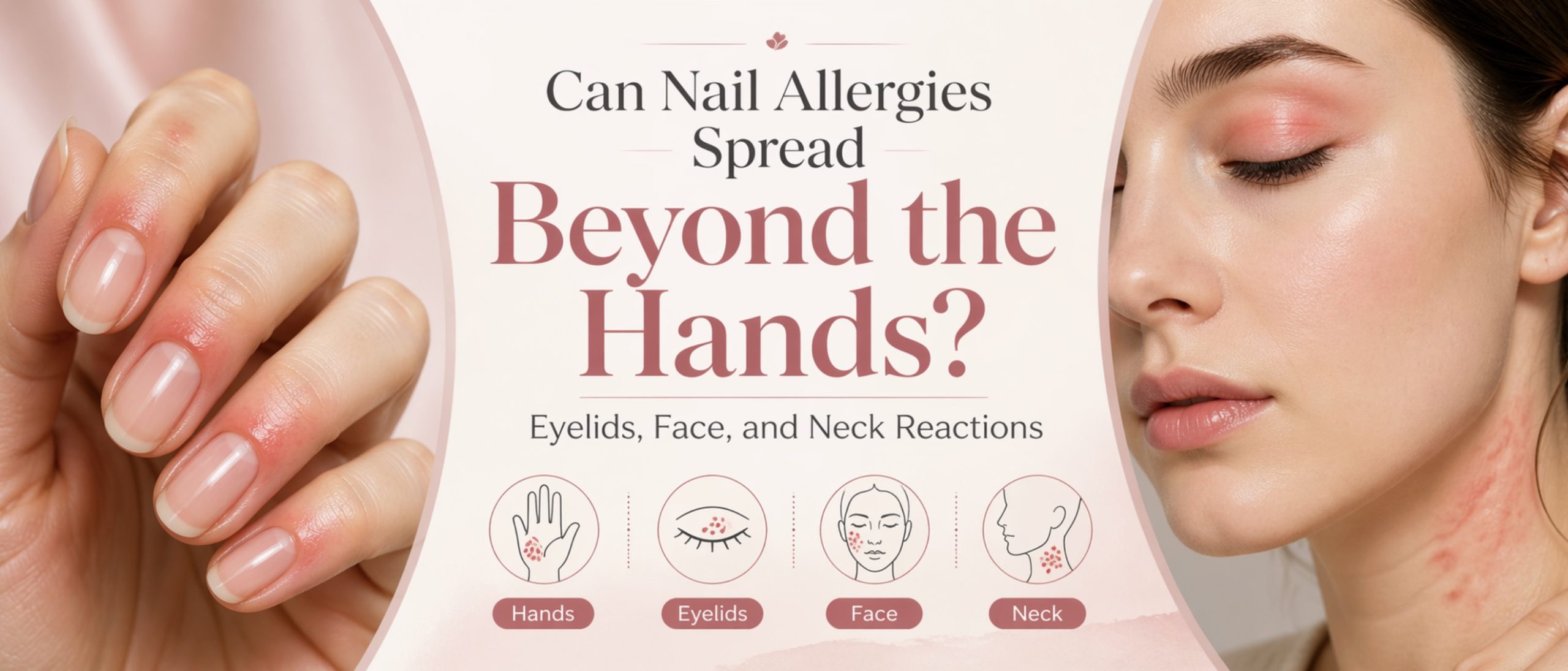
When people think of a nail allergy, they usually picture itchy fingers, red cuticles, or peeling skin around the nails. But here is the sneaky little plot twist: nail allergies do not always stay on the hands. Sometimes the reaction shows up on your eyelids, cheeks, lips, neck, or even other areas you touch throughout the day.
So if your nails look freshly done but your eyelids are suddenly itchy, your face feels irritated, or your neck has a random rash, your manicure could still be part of the story. Nail cosmetic allergies can be tricky like that. The allergen may start on your nails or fingertips, then travel by touch to delicate skin that reacts faster and more dramatically.
This guide explains can nail allergies spread beyond the hands, why eyelid and face reactions happen, what symptoms to watch for, which nail products are common triggers, and what to do when your cute manicure starts causing not-so-cute skin drama.
Gentle essentials for sensitive nail and skin days
If your skin is acting fussy after nail products, these are helpful categories to look at while you simplify your routine and avoid extra irritation:
- Fragrance-free hand creams for dry, reactive hands and cuticles
- Cuticle oils for sensitive skin to keep the nail area soft without heavy fragrance
- HEMA-free gel polish options for comparing lower-HEMA nail formulas
- Nitrile gloves for nail work to reduce direct contact during messy product steps
- Gentle gel nail removal kits to avoid peeling, scraping, and extra nail stress
Can Nail Allergies Really Affect Your Eyelids, Face, and Neck?
Yes, nail allergies can show up beyond the hands. This does not mean the allergy is “spreading” like an infection. It means the allergen or residue from a nail product can transfer to other areas, especially when you touch your face, rub your eyes, adjust your hair, apply skincare, or sleep with your hands near your face.
The eyelids are especially sensitive because the skin there is thin and delicate. A tiny amount of allergen that barely bothers thicker skin on the hands may cause obvious irritation around the eyes. That is why some people get eyelid dermatitis even when their fingers look only mildly dry or itchy.
Nail products can also cause reactions on the cheeks, lips, chin, jawline, neck, and upper chest. It can feel super confusing because the rash may appear far away from where the product was applied. But with nail cosmetic allergies, distance does not always mean unrelated.
Love easy Hema Free Builder Gel - Hypoallergenic Strong Base Coat | Long-Lasting Adhesion (30+ Days) for Professional Nails Gift for Women

Beetles 15ml HEMA-Free Nail Glue Gel, TPO Free UV Nail Glue

Beetles HEMA-Free Builder Gel with Base and No Wipe Top Coat 3PCS 15ML

Dr. G's Clear Nail Antifungal Treatment, 0.5 Fluid Ounce
Why Eyelids React So Easily
Your eyelid skin is thinner than most other skin on the body. It has less barrier protection and tends to react quickly to irritants and allergens. That is why eyelids can flare from things like skincare, fragrance, hair products, jewelry metals, airborne allergens, and yes, nail products.
Think about how often your hands touch your face during the day. You rub your eyes when tired, scratch your nose, fix your lashes, apply moisturizer, check makeup, tuck hair behind your ear, or rest your face on your hand. If your nails or fingertips carry tiny amounts of nail product residue, your eyelids may be the first place to complain.
This is why eyelid rashes can sometimes be caused by nail polish, gel polish, acrylic nails, nail glue, or artificial nails even when the product never intentionally went near your eyes.
What Nail Allergy on the Eyelids Can Look Like
Eyelid reactions from nail cosmetics can look like regular eczema, skincare irritation, seasonal allergies, or even a makeup reaction. That is what makes it so sneaky.
Common eyelid symptoms include:
- itchy eyelids
- redness around the eyes
- dry, flaky eyelid skin
- puffy or swollen eyelids
- burning or stinging
- tight, crepey-looking skin
- peeling near the lash line
- rash that comes and goes after manicures
If your eyelids flare after gel nails, acrylics, press-ons, dip powder, or nail glue, do not only blame your eye cream. Your manicure may be the hidden trigger.
What Nail Allergy on the Face Can Look Like
Face reactions can show up on the cheeks, around the mouth, along the jawline, near the nose, or on the forehead. Sometimes the rash appears patchy and dry. Other times it feels itchy, hot, bumpy, or swollen.
Facial symptoms may include:
- itchy patches on the cheeks or jaw
- redness that looks like irritation
- small bumps or rough texture
- dry, scaly skin
- burning after skincare products
- swelling around lips or cheeks
- rash that worsens after touching your face
This can be extra frustrating because you may start changing your cleanser, moisturizer, makeup, sunscreen, or laundry products while the real trigger is sitting on your fingertips looking glossy and innocent.
What Nail Allergy on the Neck Can Look Like
The neck can react when allergens transfer from your hands, nails, hair, pillowcase, or jewelry area. You may touch your neck while applying perfume, adjusting necklaces, moving hair, or resting your hand near your collarbone.
Neck reactions may look like:
- itchy red patches
- dry or flaky skin
- rash along the sides of the neck
- irritation near the collarbone
- burning when applying perfume or lotion
- rough texture that keeps returning
If the rash appears after nail services or at-home gel manicures, nail product transfer should be on your list of possible causes.
Is the Allergy Actually Spreading?
Most of the time, nail allergy is not spreading in the way an infection spreads. Allergic contact dermatitis is not contagious. You cannot pass it to someone else by touching them.
What can happen is allergen transfer. This means the ingredient causing the reaction is carried from your nails or hands to another area of skin. Another possibility is a more widespread immune response after sensitization, where the body reacts in places beyond the original contact site.
Either way, the important thing is this: a rash away from the nails does not rule out nail products as a trigger.
Common Nail Products That Can Trigger Reactions Beyond the Hands
Many nail products can cause contact dermatitis in sensitive people. Some reactions are irritant reactions, while others are true allergies. The products most often suspected include:
- gel polish
- builder gel
- hard gel
- Gel X-style extension products
- acrylic liquid and powder systems
- dip powder liquids
- nail glue
- press-on nail adhesive
- base coats and top coats
- primers and dehydrators
- regular nail polish resins
- fragranced cuticle oils or hand creams
Gel and acrylic systems get a lot of attention because they often contain acrylates or methacrylates, ingredients that help products bond, harden, or cure. These ingredients can cause allergic contact dermatitis in some people, especially when uncured product touches the skin repeatedly.
Why Gel Polish Is a Common Suspect
Gel polish is designed to cure under a UV or LED lamp. When used correctly, the product should harden fully. But problems can happen when gel touches the skin, is applied too thickly, is cured with the wrong lamp, or remains under-cured.
Uncured or partially cured gel ingredients may increase the chance of sensitization. Once sensitized, future exposure can trigger symptoms faster. This is one reason people sometimes say, “I used gel for years and suddenly became allergic.” That can happen.
If you still do gel at home, be extra careful to keep product off your skin, use thin coats, cure properly, and clean the cuticle area before curing. A small gel nail cleanup brush can help remove polish from the sidewalls and cuticles before your hand goes under the lamp.
Why Nail Glue Can Cause Face and Eyelid Reactions
Nail glue is another possible trigger, especially with press-ons, broken nail repairs, and artificial nail tips. Many nail glues contain cyanoacrylate-based adhesives. These can irritate or cause allergic reactions in some people.
If you apply press-ons and then touch your face before the glue is fully dry, or if glue residue remains around the nail, transfer may happen. Glue can also irritate the skin around the nail if too much is applied and it spills onto the cuticles.
If you use press-ons often, consider comparing press-on nail adhesive tabs with traditional glue. Adhesive tabs are not allergy-proof, but some people find them less messy and easier to remove.
How Nail Allergens Travel to the Face
Nail allergens can travel through direct touch, residue, dust, or contaminated tools. You might not see the product on your skin, but tiny amounts can still be enough to trigger a sensitive area.
Common transfer habits include:
- rubbing your eyes after doing nails
- touching your eyelids while removing makeup
- applying skincare with freshly done nails
- sleeping with your hands near your face
- touching your neck or jawline repeatedly
- brushing hair away from your face
- using tools or towels with nail product residue
This is why washing hands after nail work matters so much. It is also why nail techs and DIY users should avoid touching the face during application, filing, curing, or removal.
Could Nail Dust Cause Reactions Away From the Hands?
Nail dust can irritate the skin and may carry product particles, especially when filing acrylic, builder gel, hard gel, or dip powder. Nail techs and frequent DIY users may notice irritation on the hands, wrists, face, neck, or areas exposed during filing.
A nail dust collector for acrylic and gel filing can help reduce airborne dust around your workspace. For frequent filing, you may also want to look at protective masks for nail dust and closed storage to keep dust from settling on products and surfaces.
Dust control does not replace allergy care, but it can make your nail area cleaner and less irritating overall.
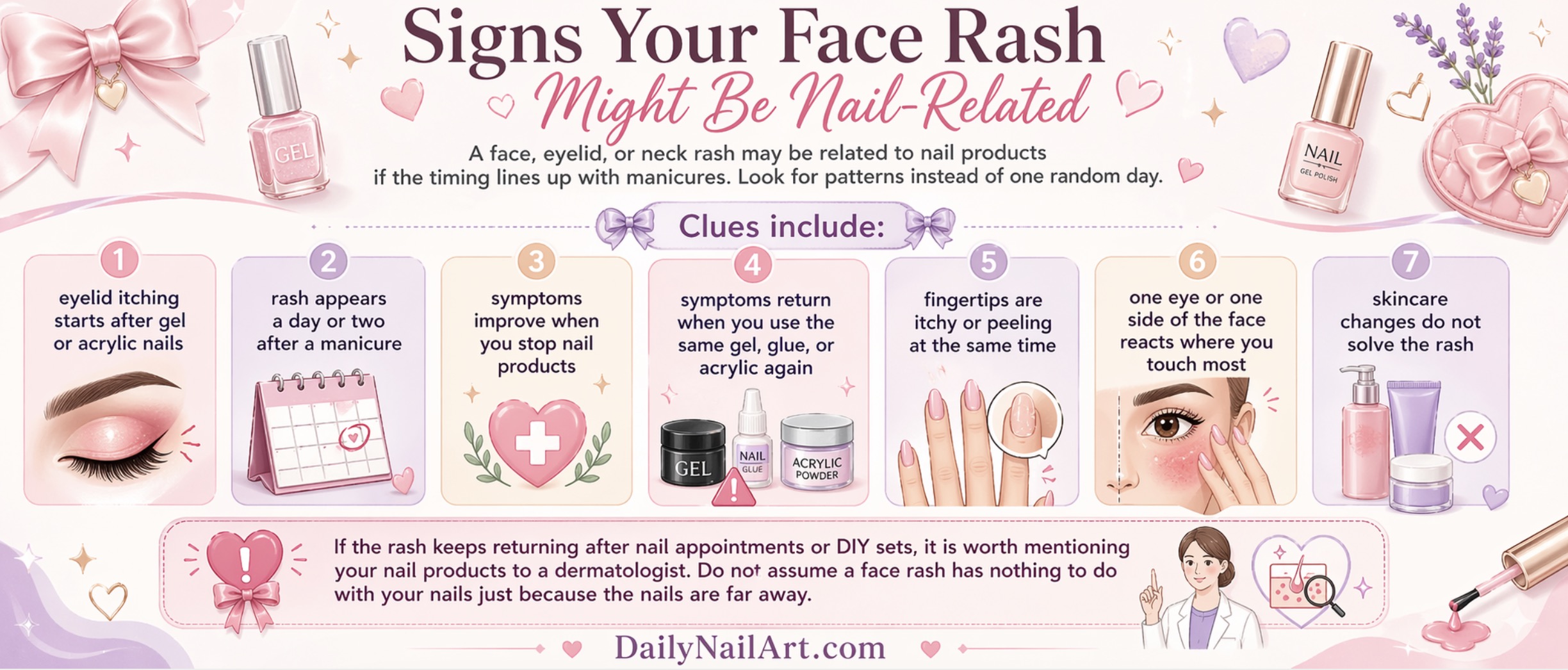
Signs Your Face Rash Might Be Nail-Related
A face, eyelid, or neck rash may be related to nail products if the timing lines up with manicures. Look for patterns instead of one random day.
Clues include:
- eyelid itching starts after gel or acrylic nails
- rash appears a day or two after a manicure
- symptoms improve when you stop nail products
- symptoms return when you use the same gel, glue, or acrylic again
- fingertips are itchy or peeling at the same time
- one eye or one side of the face reacts where you touch most
- skincare changes do not solve the rash
If the rash keeps returning after nail appointments or DIY sets, it is worth mentioning your nail products to a dermatologist. Do not assume a face rash has nothing to do with your nails just because the nails are far away.
Nail Allergy vs Skincare Reaction
Nail allergy and skincare irritation can look very similar. Both can cause redness, itching, burning, dry patches, swelling, and peeling. The difference often comes down to timing, location, and repeated patterns.
A skincare reaction may happen shortly after applying a new product directly to the area. A nail allergy may flare after a manicure, after nail product use, or after touching the face with manicured fingers. Eyelid reactions are especially suspicious because eyelids often react to allergens transferred from the hands.
To help narrow it down, keep a simple beauty diary for a few weeks. Note nail products, skincare products, symptoms, timing, and where the rash appears. This can be very helpful if you see a dermatologist.
Nail Allergy vs Infection
Allergic reactions are not the same as infections. Contact dermatitis usually causes itching, redness, swelling, peeling, bumps, or blisters. Infection may cause increasing pain, pus, warmth, spreading redness, swelling, odor, or fever.
If your skin is painful, hot, draining fluid, crusting heavily, or spreading quickly, do not assume it is just an allergy. Get medical advice. Also, if your eye area is very swollen or painful, treat that as urgent enough to contact a healthcare professional.
What to Do If You Suspect a Nail Allergy Beyond the Hands
First, pause the suspected nail products. That includes gel polish, acrylics, nail glue, dip liquids, primers, and any product you think may be triggering the rash. Do not keep doing new sets to test your theory. Repeated exposure can make allergic reactions worse.
Wash your hands gently and avoid touching your face. Keep skincare simple. Avoid fragrance-heavy creams, scrubs, acids, retinoids, or anything that stings on the irritated area until your skin calms down.
If you have nail product on and symptoms are flaring, removal may be needed. For soak-off gel, a gel nail removal kit can help you avoid peeling and ripping. For acrylic, hard gel, severe reactions, or painful nails, professional removal may be safer.
Do Not Put More Product Over the Problem
It is tempting to cover lifting, peeling, or irritation with another coat of polish, a fresh set, or press-ons. Please do not do that if you suspect an allergy. Covering symptoms can hide warning signs and may keep exposing you to the trigger.
If your eyelids are itchy, your face is rashy, or your fingers are peeling after nail products, your skin needs a break. Think of it as a recovery era. Soft hands, gentle care, no drama.
How to Reduce Transfer to the Face
While figuring out your trigger, reduce accidental transfer as much as possible.
- Wash hands after doing nails or handling nail products.
- Avoid touching your eyes during nail application or removal.
- Keep gel, acrylic, glue, and primer off your skin.
- Clean sidewalls and cuticles before curing gel.
- Use thin gel coats and cure properly.
- Keep nail tools and towels clean.
- Do not sleep with uncured or sticky product residue on your hands.
- Use gloves for messy product handling if appropriate.
For DIY nail lovers, lint-free nail wipes and a cleanup brush can make application cleaner, which helps reduce accidental skin exposure.
Can HEMA-Free Gel Help?
HEMA-free gel may help some people reduce exposure to one commonly discussed gel allergen. HEMA is short for hydroxyethyl methacrylate, an ingredient used in many gel nail products. But HEMA-free does not mean allergy-proof.
Other acrylates, methacrylates, resins, pigments, or additives can still cause reactions. Also, even a lower-allergen formula can irritate skin if it is under-cured or repeatedly painted onto the cuticles.
If you are browsing HEMA-free gel polish for sensitive skin, treat it as a product comparison category, not a guaranteed safe solution. If you already have a confirmed acrylate allergy, ask a dermatologist before trying more gel products.
Should You Switch to Regular Nail Polish?
Regular nail polish may be a better option for some people who react to gel or acrylic systems. Traditional polish does not require curing in a lamp and may avoid some gel-related acrylate exposure. But regular polish can still contain allergens, including resins, pigments, fragrances, or preservatives.
You can look at regular nail polish sets if you want a lower-commitment manicure option while avoiding gel systems. Patch testing and medical advice are still the best way to know what you personally need to avoid.
What About Press-Ons?
Press-ons can be a cute alternative, but they are not automatically allergy-free. Nail glue can trigger reactions in some people, and adhesive tabs can also irritate sensitive skin. Press-ons can also trap moisture if they lift or are applied poorly.
If you want to try press-ons after a suspected gel allergy, consider starting with adhesive tabs for press-on nails instead of glue, and wear them for shorter periods at first. Stop immediately if itching, redness, swelling, or rash returns.
When to See a Dermatologist
See a dermatologist or qualified healthcare professional if your rash is recurring, severe, spreading, painful, blistering, affecting your eyes, or not improving after stopping nail products. Eyelid swelling, eye pain, vision changes, or significant facial swelling should be taken seriously.
A dermatologist may recommend patch testing. Patch testing can help identify specific allergens, such as acrylates, methacrylates, resins, fragrances, preservatives, or nail glue ingredients. This is much better than guessing and accidentally buying products with similar triggers.
This article is for informational purposes only and is not a diagnosis or treatment plan. If your skin is angry, your eyes are involved, or symptoms keep returning, get professional medical advice.
What to Tell Your Doctor
When you see a doctor or dermatologist, mention your nail routine clearly. This includes salon gel, DIY gel kits, acrylics, Gel X-style tips, builder gel, dip powder, nail glue, press-ons, primers, dehydrators, top coats, removers, and cuticle oils.
Bring photos of the rash if it comes and goes. Bring product names or ingredient lists if you have them. Mention whether the rash appears after manicures, whether your fingers itch too, and whether your eyelids, face, or neck are involved.
The more specific you are, the easier it is for a professional to connect the dots.
How Long Can Nail Allergy Symptoms Last?
Symptoms may calm down after you stop exposure, but the timeline varies. Mild irritation may improve in days. Allergic contact dermatitis can take longer, especially if the trigger remains on the nails or keeps transferring to the face.
If symptoms do not improve, keep returning, or worsen, do not keep waiting with a full set on. Get help. The goal is to remove the trigger and support the skin barrier, not keep re-exposing the area.
Can You Become Allergic Suddenly?
Yes. Nail allergies can seem sudden because sensitization can build over time. You might use gel, acrylic, or nail glue many times without obvious symptoms and then one day react strongly.
This is why mild signs matter. Itchy fingertips after gel nails, peeling cuticles, eyelid rash after manicures, or repeated face irritation are all clues worth taking seriously.
How Nail Techs Can Reduce Exposure
Nail techs may have higher exposure because they handle products and dust repeatedly. If you work with clients, keep products off your skin, use good ventilation and dust control, change gloves when contaminated, clean tools and surfaces properly, and avoid touching your face during services.
A professional nail dust collector, good storage, and clean application habits can make your workspace feel more controlled. But if you develop symptoms, do not just push through. Occupational allergies can become a serious problem for nail professionals.
Beginner Checklist: Could My Nail Allergy Be Affecting My Face?
Use this little checklist if you are trying to figure out whether your manicure could be connected to your eyelid, face, or neck reaction:
- Did the rash start after a manicure or nail product change?
- Do your eyelids itch after gel, acrylic, or press-ons?
- Do your fingertips also itch, peel, or swell?
- Does the rash improve when you stop nail products?
- Does it return when you use the same product again?
- Do you touch your eyes or face often with manicured hands?
- Have skincare changes failed to fix it?
- Are you using gel, acrylic, nail glue, dip liquids, or primers?
If several of these sound familiar, nail products may be worth investigating.
Frequently Asked Questions
Can nail allergies cause eyelid dermatitis?
Yes. Nail product allergens can transfer from the fingers to the eyelids, where the skin is thin and sensitive. This can cause itching, redness, swelling, dryness, or peeling around the eyes.
Can a gel nail allergy show up on the face?
Yes. Gel nail allergens can sometimes cause reactions on the face, especially if product residue transfers by touch. Cheeks, lips, jawline, eyelids, and neck can all be affected.
Is a nail allergy contagious?
No. Allergic contact dermatitis is not contagious. It is a skin reaction to an allergen or irritant, not something you spread to another person.
Why are my eyelids reacting if my nails look fine?
Eyelid skin is very delicate and may react to tiny amounts of allergen transferred from your hands. Your nails may look fine while your eyelids show the reaction more clearly.
Should I remove my gel nails if my face or eyelids react?
If you suspect your nail products are causing a reaction, pausing exposure is important. Removal may be needed, but it should be gentle and safe. For severe eyelid, face, or skin symptoms, contact a healthcare professional.
Does HEMA-free gel prevent eyelid reactions?
Not always. HEMA-free gel removes one commonly discussed ingredient, but other ingredients can still trigger reactions. It is not guaranteed allergy-proof.
When should I see a doctor for a nail allergy?
See a healthcare professional if symptoms are severe, recurring, spreading, painful, blistering, near your eyes, or not improving after stopping nail products.
Final Thoughts
Nail allergies can absolutely show up beyond the hands. Eyelids, face, and neck reactions can happen when allergens from gel polish, acrylics, nail glue, dip liquids, or other nail cosmetics transfer by touch or trigger dermatitis away from the original contact area.
If your eyelids itch after manicures, your face flares after gel nails, or your neck rash keeps appearing around nail appointments, do not ignore the pattern. Pause the suspected products, keep your routine gentle, avoid touching your face during nail work, and talk to a dermatologist if symptoms return or worsen.
Your nails can still be beautiful, but your skin gets priority. Healthy skin first, cute manicure second, sparkle when it is safe. That is the real glam routine.
Love easy Hema Free Builder Gel - Hypoallergenic Strong Base Coat | Long-Lasting Adhesion (30+ Days) for Professional Nails Gift for Women
Beetles 15ml HEMA-Free Nail Glue Gel, TPO Free UV Nail Glue
Beetles HEMA-Free Builder Gel with Base and No Wipe Top Coat 3PCS 15ML