
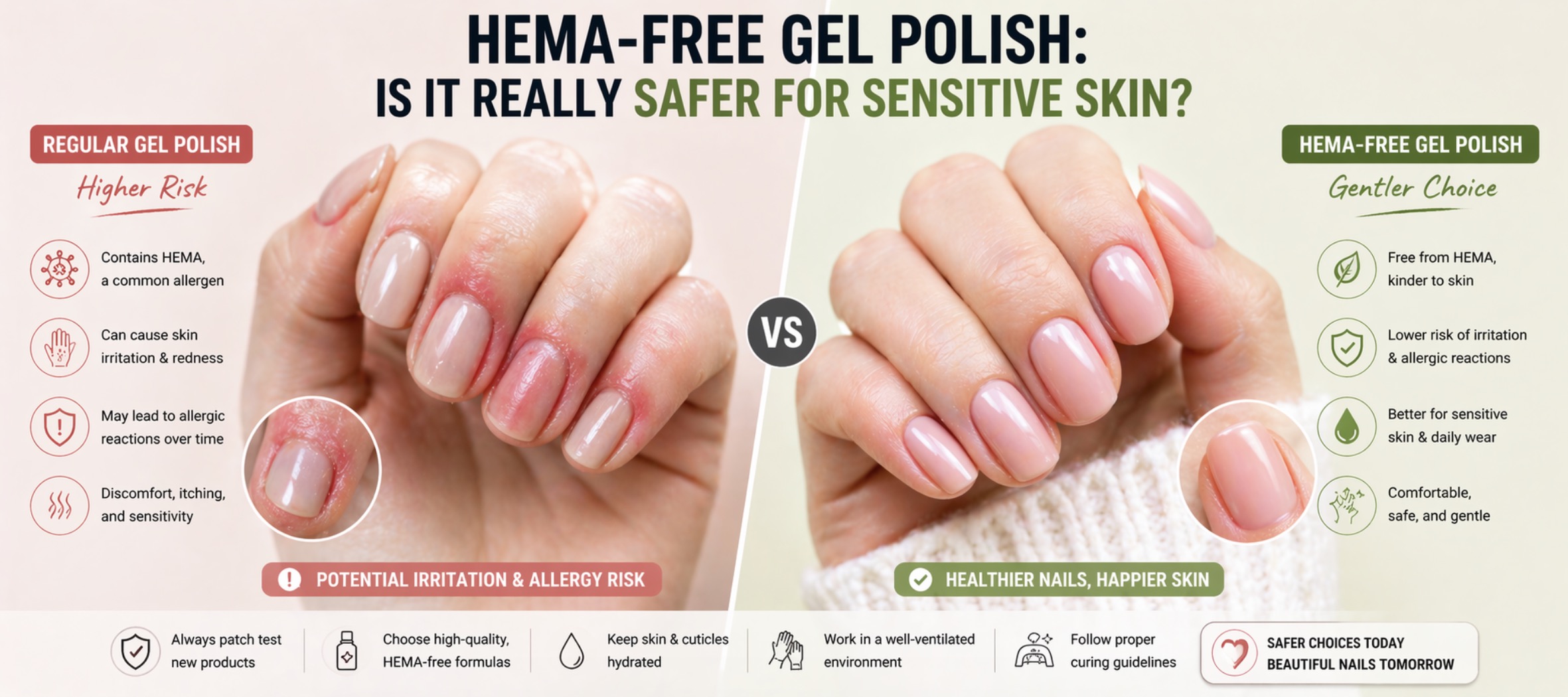
If you have sensitive skin and the words HEMA-free gel polish keep showing up all over your nail research, you are definitely not alone. The nail world loves to throw that label around like it is a magical little safety blanket, and honestly, I get why. If your fingers have ever felt itchy, swollen, rashy, or just generally offended after a gel manicure, seeing “HEMA-free” sounds very promising.
But here is the real question: is HEMA-free gel polish actually safer for sensitive skin? The answer is a little more nuanced than the marketing sometimes makes it sound. HEMA-free can absolutely be a better option for some people, especially if HEMA seems to be a trigger. But it does not automatically mean allergy-proof, irritation-proof, or universally safe for every sensitive nail person on earth.
If you have been searching for HEMA-Free Gel Polish: Is It Really Safer for Sensitive Skin?, this guide is here to break it all down in a simple, cute, not-too-overwhelming way. We’re going to talk about what HEMA actually is, why people care about avoiding it, what dermatologists and allergy conversations usually mean when they bring it up, how HEMA-free gel compares with regular gel, and what sensitive-skin nail girlies should realistically keep in mind before assuming one label solves everything.
Because glossy nails are lovely. Mystery irritation and itchy cuticles? Absolutely not the dream manicure energy.
Cute little basics for a gentler gel routine
If you are trying to be more careful with sensitive skin or just want a neater gel routine overall, these are the kinds of basics worth looking at:
- HEMA-free gel polish if you want to compare formulas marketed for sensitive users
- HEMA-free builder gel if builder products are part of your routine too
- UV LED nail lamps for proper curing and a more controlled gel setup
- Gel cleanup brushes to help keep product off the skin
- Hand cream for dry cracked skin to support the skin barrier around the nails
What Is HEMA?
HEMA stands for hydroxyethyl methacrylate, which is one of the many acrylate ingredients used in nail products. It helps certain gels stick, cure, and perform the way they are supposed to. Very useful little ingredient from a product-performance point of view. Less adorable from a sensitive-skin point of view.
HEMA is one of the ingredients that gets talked about a lot in connection with nail allergies and allergic contact dermatitis, especially in gel products. That is why it shows up so often in ingredient warnings, salon education, and sensitive-skin nail conversations.
Why Do People Worry About HEMA So Much?
The biggest reason is that HEMA has been linked to allergic reactions in some people, especially when uncured gel touches the skin over and over again. Once someone becomes sensitized, even a small amount of future exposure can trigger symptoms again.
This is why a lot of people who develop gel-related itching or dermatitis start hearing about HEMA pretty quickly. It is not the only possible trigger in gel products, but it is one of the most talked-about ones.
Basically, HEMA is not automatically a problem for everyone, but if someone has sensitive skin, repeated skin exposure to gel ingredients, or a history of nail product reactions, it becomes a lot more relevant.
What Does HEMA-Free Actually Mean?
HEMA-free means the product does not contain HEMA specifically. That is all it guarantees.
It does not automatically mean:
- the product is allergy-proof
- the product is safe for everyone
- the product cannot irritate sensitive skin
- the product contains no other acrylates
This is the part where the marketing can get a little too dreamy. HEMA-free can be meaningful and helpful, yes. But it is not a magical “zero risk” label.
So… Is HEMA-Free Gel Polish Actually Safer?
For some people, yes. For everyone, not automatically.
HEMA-free gel polish can be safer for some sensitive users because it removes one ingredient that is commonly discussed in nail allergy conversations. If HEMA is the main problem ingredient for someone, avoiding it may reduce the chance of a reaction.
But here is the important little reality check: many HEMA-free products still contain other acrylates or methacrylates that can also irritate the skin or trigger allergic reactions in some people.
So the better answer is really this:
- HEMA-free may be better for some sensitive users
- HEMA-free is not automatically safe for all sensitive users
That is why the label can be helpful, but it should not be the only thing you rely on when deciding what your skin can tolerate.
Why Sensitive Skin People Often Switch to HEMA-Free
A lot of people start looking into HEMA-free gel polish after experiencing things like:
- itchy cuticles
- redness around the nails
- swollen fingertips
- peeling or cracked skin
- rashy skin after gel manicures
- ongoing sensitivity to builder gel or gel overlays
If the skin clearly starts acting up around gel products, removing one common suspect from the routine makes a lot of sense. It is a reasonable thing to explore. It just is not a guarantee.
What Sensitive Skin Reactions to Gel Can Look Like
If someone is reacting to gel products, symptoms often show up around the skin more than the nail itself. Common signs include:
- itching around the cuticles or fingertips
- red, irritated skin around the nail folds
- swelling
- burning or stinging
- dry, flaky, or cracked skin
- tiny bumps or blister-like spots
- rash on the face or eyelids after touching the skin
If this keeps happening with gel, that is not something to casually ignore just because the nails still look shiny and cute from the top.
What Usually Causes Reactions: The Formula or the Application?
Honestly, often both.
Even a supposedly gentler formula can still cause trouble if the application is messy. Sensitive skin people are much more likely to have issues when:
- gel touches the skin
- the product floods into the cuticle area
- layers are too thick
- the lamp does not cure the product properly
- the natural nail or surrounding skin is already damaged
That is why a neater setup matters so much. A proper UV LED nail lamp, a slim gel cleanup brush, and a little patience with thin layers can matter just as much as the label on the bottle.
Why Proper Curing Matters So Much
Under-cured gel is a huge issue for sensitive skin because uncured or partly cured product is more likely to cause irritation and increase skin exposure problems. If your lamp is weak, incompatible, or old, the formula may not cure the way it is supposed to.
That means even a HEMA-free product can still be a problem if the whole curing setup is messy or unreliable.
Can HEMA-Free Still Cause an Allergy?
Yes, it can. That is the big thing people often do not realize right away.
HEMA-free products can still contain other ingredients that some people react to, especially if they already have a history of acrylate allergy or repeated gel sensitivity. So if someone is already sensitized to multiple nail product ingredients, switching to HEMA-free is not always enough.
Basically, HEMA-free lowers one common concern. It does not erase all the others.
Who Might Benefit Most From HEMA-Free Gel Polish?
HEMA-free formulas may be worth looking into if:
- your skin seems generally sensitive to regular gel
- you have had mild irritation and want a gentler-feeling option
- you are trying to reduce ingredient exposure where you can
- you want to compare formulas before giving up gel completely
Again, it is not a guarantee, but for some people it is a very reasonable step in a less-reactive direction.
Who Should Be More Careful Even With HEMA-Free?
You should be especially cautious if:
- you already had strong allergic reactions to gel
- you get swelling, blistering, or rash every time
- you have known acrylate allergies
- your skin is already damaged or inflamed around the nails
In those cases, simply switching labels may not be enough, and it may be smarter to take a full break and talk to a dermatologist if reactions keep happening.
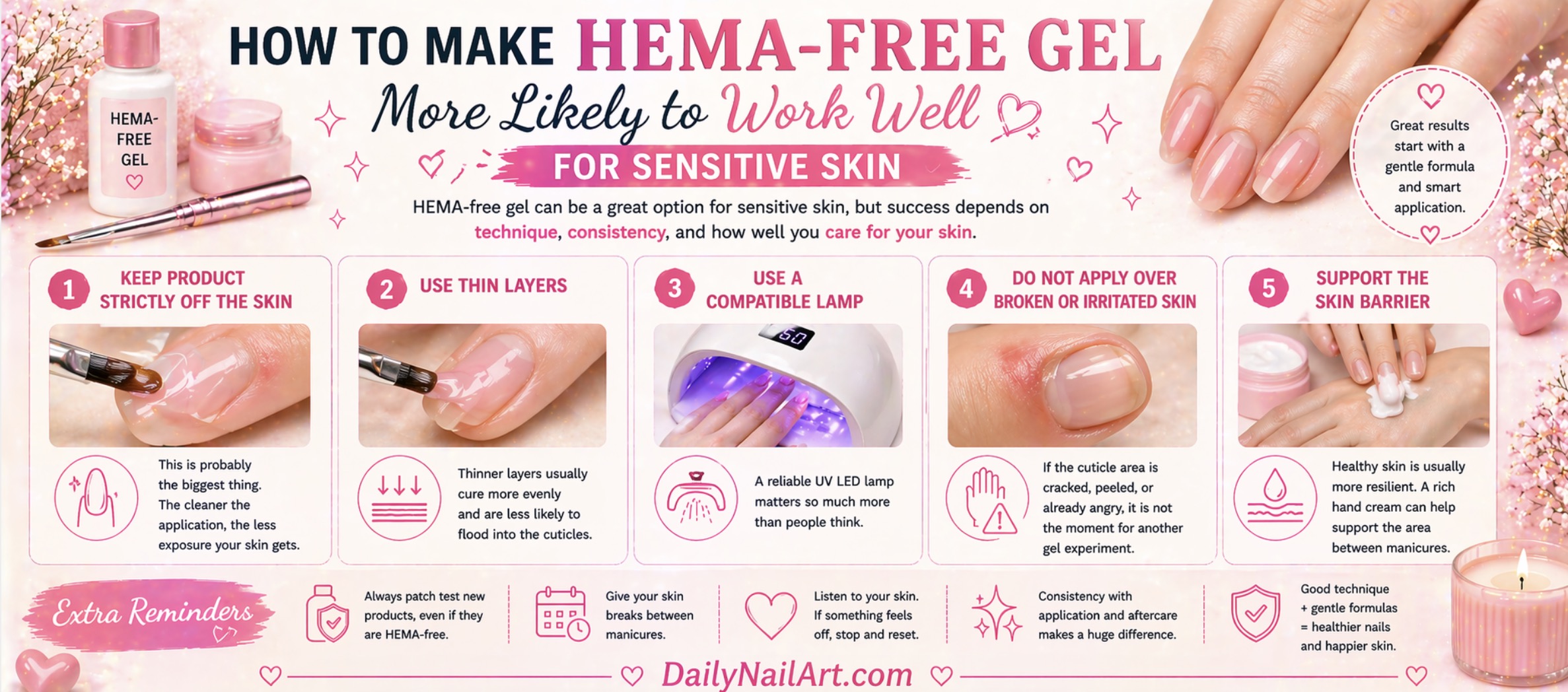
How to Make HEMA-Free Gel More Likely to Work Well for Sensitive Skin
If you want to try a HEMA-free formula, how you use it matters so much.
Keep Product Strictly Off the Skin
This is probably the biggest thing. The cleaner the application, the less exposure your skin gets.
Use Thin Layers
Thinner layers usually cure more evenly and are less likely to flood into the cuticles.
Use a Compatible Lamp
A reliable UV LED lamp matters so much more than people think.
Do Not Apply Over Broken or Irritated Skin
If the cuticle area is cracked, peeled, or already angry, it is not the moment for another gel experiment.
Support the Skin Barrier
Healthy skin is usually more resilient. A rich hand cream can help support the area between manicures.
What to Do If Regular Gel Always Makes You React
If regular gel keeps causing symptoms and even HEMA-free does not seem to fix it, you may need to simplify your nail routine instead of forcing the gel relationship to work.
Some people do better with:
- a break from gel completely
- regular polish instead of gel
- short press-ons worn carefully
- natural nail care while the skin recovers
If you need a break, a pretty regular nail polish set or some short press-on nails can still let you have cute nails without the same kind of gel exposure.
When to See a Dermatologist
You should seriously think about seeing a dermatologist if:
- you get the same rash every time after gel
- the skin swells, blisters, or cracks badly
- your eyelids or face react too
- even HEMA-free formulas still seem to trigger you
- you want patch testing to better understand what you are reacting to
Patch testing can be really helpful when you need more than guessing and trial-and-error.
Common Mistakes People Make With HEMA-Free Gel
Assuming the Label Means Zero Risk
It does not. It just means HEMA is not in that formula.
Still Flooding the Cuticles
Even a gentler formula is not going to love being smeared all over the skin.
Using a Bad or Incompatible Lamp
Under-cured product can ruin the whole “safer routine” idea pretty quickly.
Trying Product After Product on Already Angry Skin
If your fingers are already in full protest mode, it is usually smarter to let them calm down before experimenting again.
Frequently Asked Questions
Is HEMA-free gel polish safer for sensitive skin?
It can be safer for some people because it removes one commonly discussed allergen, but it is not automatically safe for everyone with sensitive skin.
Can you still get a reaction from HEMA-free gel?
Yes. HEMA-free products can still contain other acrylates or ingredients that may irritate the skin or trigger allergies in some people.
Why do people switch to HEMA-free gel?
People often switch because they have had itching, redness, swelling, or dermatitis with regular gel and want to reduce exposure to one commonly discussed ingredient.
Does HEMA-free mean allergy-proof?
No. It only means the product does not contain HEMA specifically. It does not guarantee that no reaction will happen.
What makes HEMA-free gel more likely to work well for sensitive skin?
Keeping product off the skin, using thin layers, curing properly with a reliable lamp, and avoiding application over broken or irritated skin all help a lot.
Final Thoughts
HEMA-free gel polish can be a better option for some people with sensitive skin, especially if regular gel seems to cause irritation or if HEMA is a likely trigger. But it is not a magical little safety shield that makes every gel manicure risk-free.
The label matters, yes, but so do your application habits, your lamp, your skin barrier, and whether the product stays off your cuticles and fingertips. Sometimes the formula is part of the problem. Sometimes the routine is too.
Because honestly, there is something very satisfying about understanding the difference between “safer” and “guaranteed safe,” making a few smarter choices, and giving your nails a routine that feels cute without constantly picking fights with your skin.
Nail Allergies - Essentials: A quick fact-based guide. Spot it, stop it, handle it - read the whole thing before your next client.

Beetles 15ml HEMA-Free Nail Glue Gel, TPO Free UV Nail Glue
Love easy Hema Free Builder Gel - Hypoallergenic Strong Base Coat | Long-Lasting Adhesion (30+ Days) for Professional Nails Gift for Women
